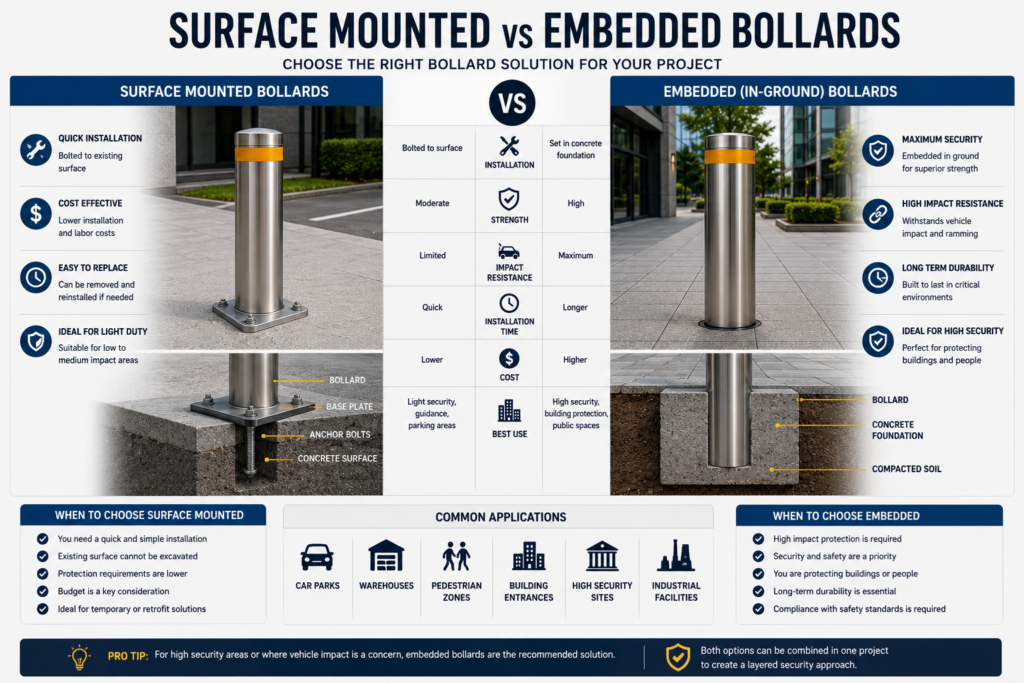

Surface Mounted vs Embedded Bollards: Which Is Right for Your Project?
Understanding the Difference Between Surface Mounted and Embedded Bollards
Choosing between surface mounted and embedded bollards is a critical decision when planning vehicle access control or security. Each type offers different levels of protection, installation requirements, and suitability depending on the environment (surface mounted vs embedded bollards).
Understanding their differences helps ensure the right solution for safety and performance.
What Are Surface Mounted Bollards?
Surface mounted bollards are installed directly onto an existing concrete surface using anchor bolts. They sit above ground and are typically quicker and easier to install.
Key Features:
- Installed on existing surfaces
- Minimal excavation required
- Faster and more cost-effective installation
- Suitable for low to medium impact protection
What Are Embedded Bollards?
Embedded bollards (also known as in-ground bollards) are installed into the ground with a concrete foundation. This method provides significantly greater strength and impact resistance.
Key Features:
- Installed below ground level
- Requires excavation and concrete footing
- High impact resistance
- Ideal for security and high-risk environments
Key Differences at a Glance
| Feature | Surface Mounted Bollards | Embedded Bollards |
|---|---|---|
| Installation | Bolted to surface | Set in concrete foundation |
| Strength | Moderate | High |
| Impact Resistance | Limited | Maximum |
| Installation Time | Quick | Longer |
| Cost | Lower | Higher |
| Best Use | Light security, guidance | High-security protection |
When to Choose Surface Mounted Bollards
Surface mounted bollards are ideal when:
- You need a quick and simple installation
- The existing surface cannot be excavated
- Protection requirements are lower
- Budget is a key consideration
Common Applications:
- Car parks
- Warehouses
- Light commercial areas
- Temporary or retrofit installations
When to Choose Embedded Bollards
Embedded bollards are the best choice when:
- High-impact protection is required
- Security is a priority
- You are protecting buildings or people
- Long-term durability is essential
Common Applications:
- Building entrances
- Public spaces and pedestrian zones
- Government and high-security sites
- Critical infrastructure
Performance and Safety Considerations
Embedded bollards provide significantly better performance under impact conditions. Because they are anchored deep into the ground, they can absorb and resist much higher forces.
Surface mounted bollards, while useful, are generally not suitable for high-security applications unless specially reinforced.
Installation Considerations
Surface Mounted:
- Requires solid concrete base
- Minimal disruption during installation
- Easier to replace or relocate
Embedded:
- Requires excavation and groundwork
- Longer installation time
- More permanent solution
Cost vs Value
Surface mounted bollards are typically more affordable upfront. However, embedded bollards offer better long-term value due to their strength, durability, and higher level of protection.
Compliance and Security Standards
For projects requiring compliance with safety or security standards (such as crash-rated systems), embedded bollards are usually required.
Can You Combine Both?
Yes — in some projects, a combination of both types may be used:
- Embedded bollards for high-risk areas
- Surface mounted bollards for secondary protection
This creates a layered security approach.
Final Recommendation
- Choose surface mounted bollards for convenience and light-duty use
- Choose embedded bollards for security, safety, and high-impact protection
Conclusion
Both surface mounted and embedded bollards have their place in modern security and access control. The right choice depends on your specific needs, budget, and level of protection required.